Anton Font - Download Free
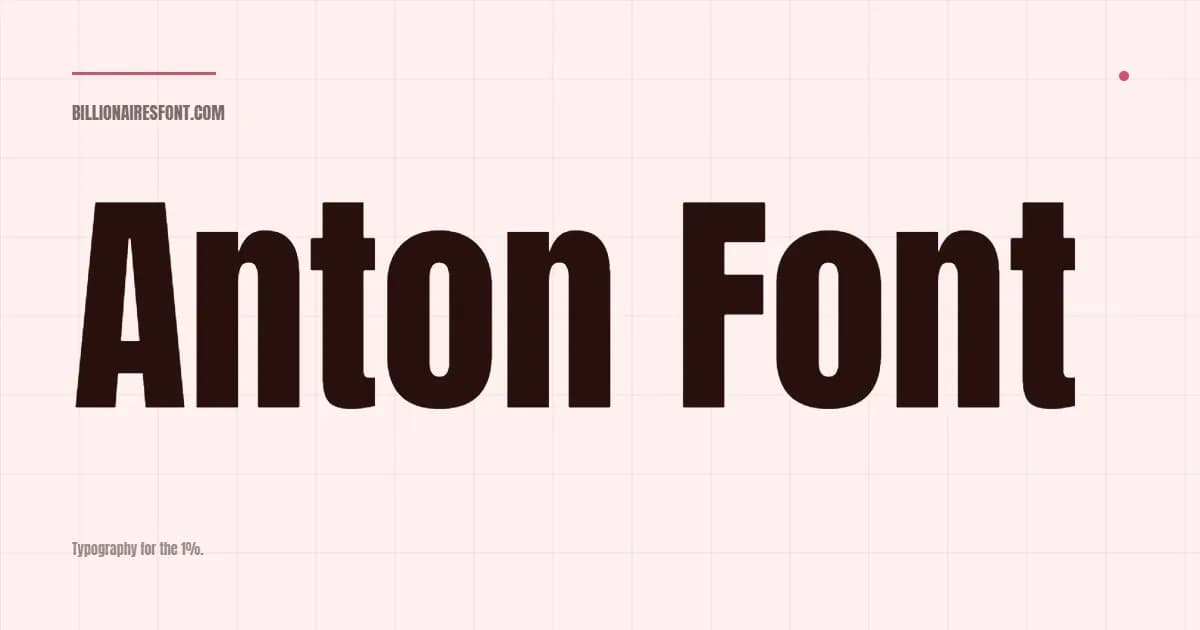
Anton font is a reworking of Anzeigen-Grotesk , the German advertising face that once filled newspaper columns and circus bills with tightly packed condensed capitals.
Vernon Adams redrew it as an open-source typeface in 2011 , keeping the original's narrow set widths and broad shouldered uppercase while pulling the lowercase up to a near-cap-height x-height that gives the Anton font its modern, screen-ready presence.
ANTON Font Gallery
TEST ANTON LIVE
TEST ANTON REGULAR LIVE
Anton in Available Styles
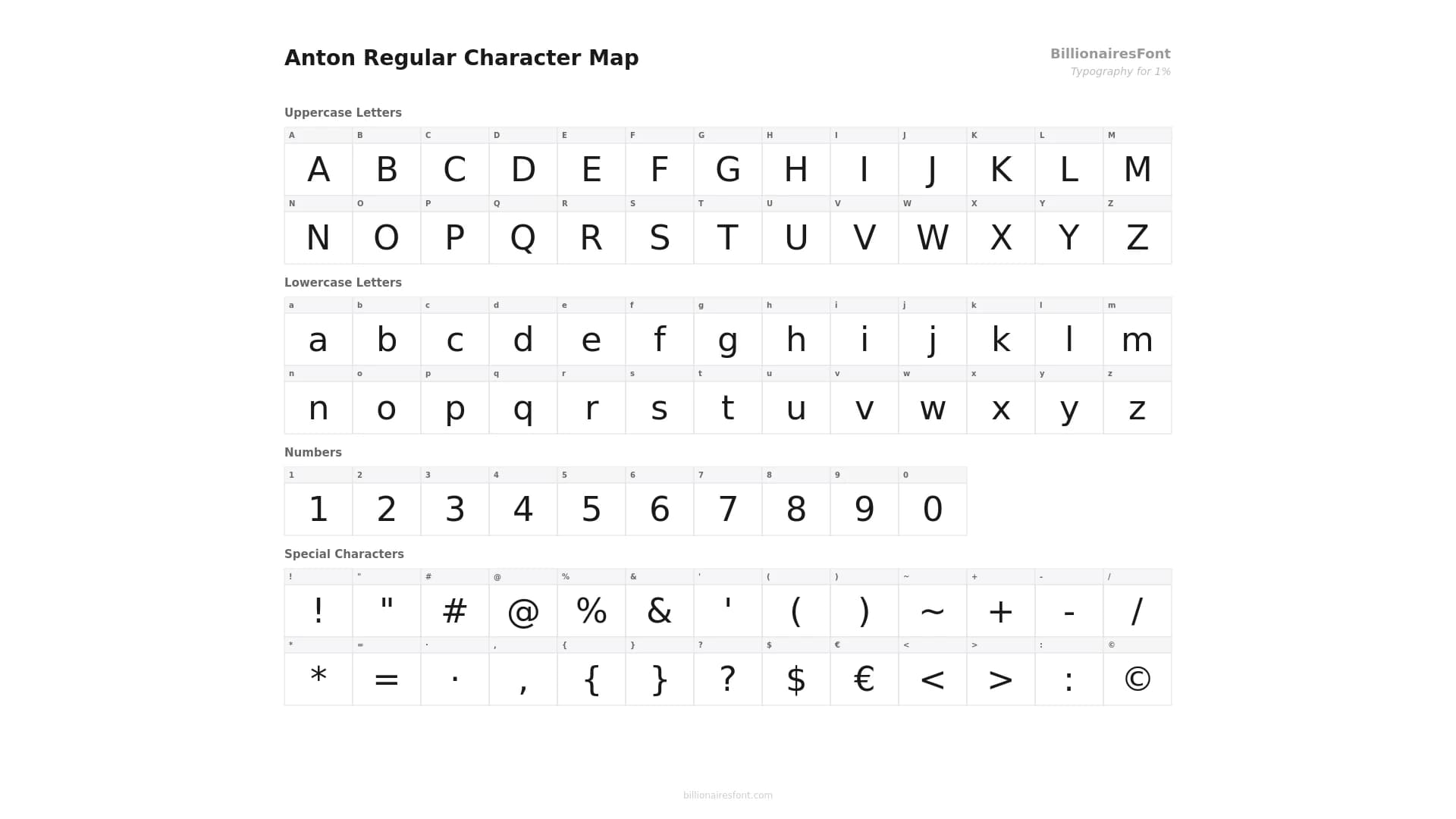
Character Map
anton regular character map
TECHNICAL SPECIFICATIONS OF ANTON
Download Anton Regular Font Family
The Anton font runs narrow. The set width is condensed without becoming spindly, and the strokes stay even from stem to bowl, so the typeface reads as solid weight rather than contrast.
The capitals are squared at the shoulders with flat, horizontal terminals - the kind of detail that gives Anton its handbill-era directness. There is no taper, no flare, no softening at the joins.
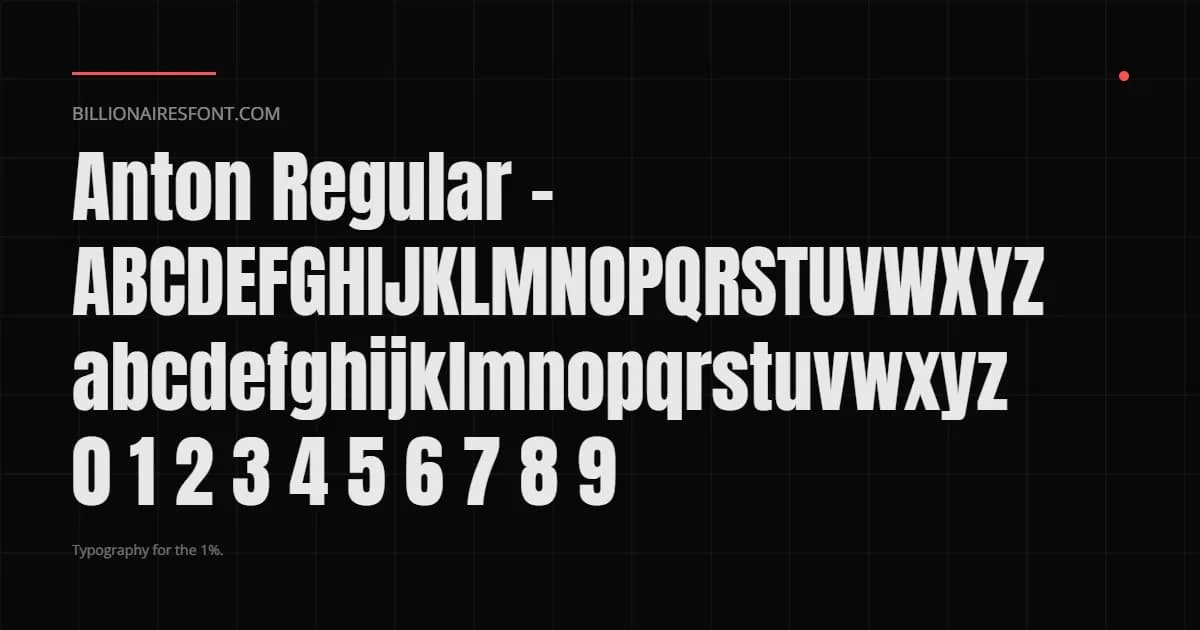
The defining trait is the x-height. Lowercase characters rise to roughly 85% of the cap height, which is unusually tall for a condensed sans serif.
That ratio compresses ascenders, flattens the visual texture of a word, and lets lowercase set lines pack together as tightly as uppercase ones. The lowercase a is double-storey with a tight aperture, the g runs single-storey with a closed tail, and the t keeps a stubby ascender that sits flush with the x-line. Diagonals on K, R, and W are kept short to preserve the overall vertical rhythm.
Pairing Anton and where it falls short
Anton ships in a single Regular weight with no italic, no extended family, and no variable axes. That sets the rules.
It cannot carry a typographic system on its own and is not built for body copy or long reading, the tall x-height and tight spacing that make the Anton font powerful at display sizes turn into noise below about 18 pixels.
It pairs cleanly with neutral text grotesques (Mona Sans, Allrounder Grotesk, Inter), with elegant transitional serifs (Instrument Serif, Albra) when contrast is the goal, and with technical monospaces (NaN Holo Mono, Tempos Mono) for editorial and music work where Anton anchors the headline and the mono carries metadata. Designers needing the same silhouette in an extended family often reach for Antonio, a multi-weight relative built on the same condensed structure.