Download Hello Headline W00 Regular Font
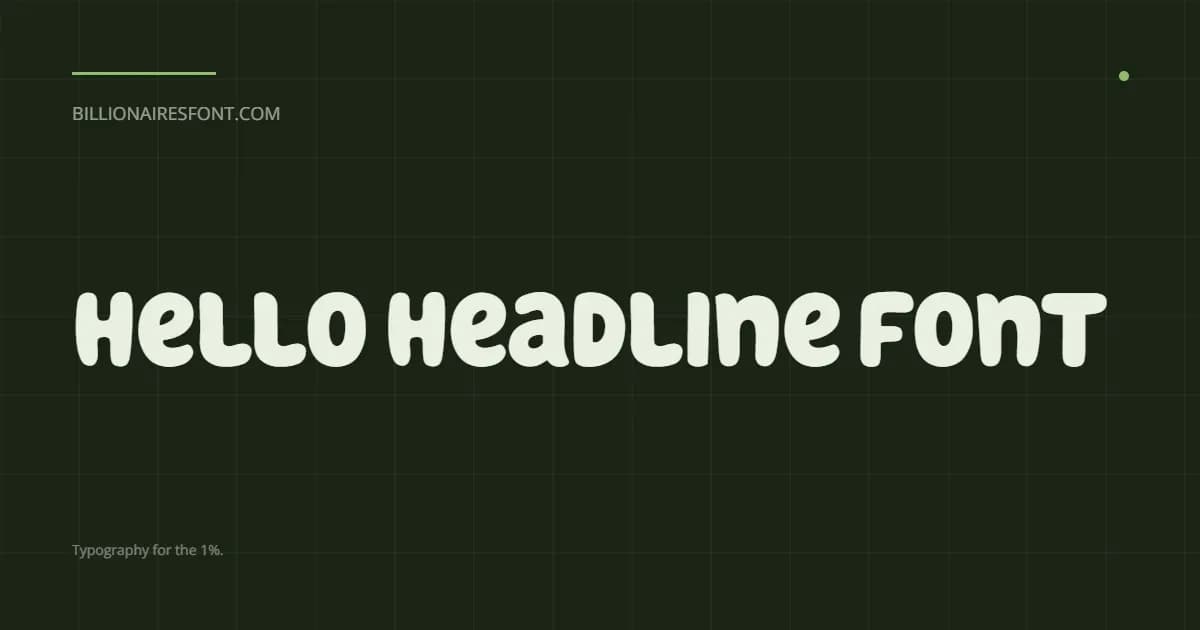
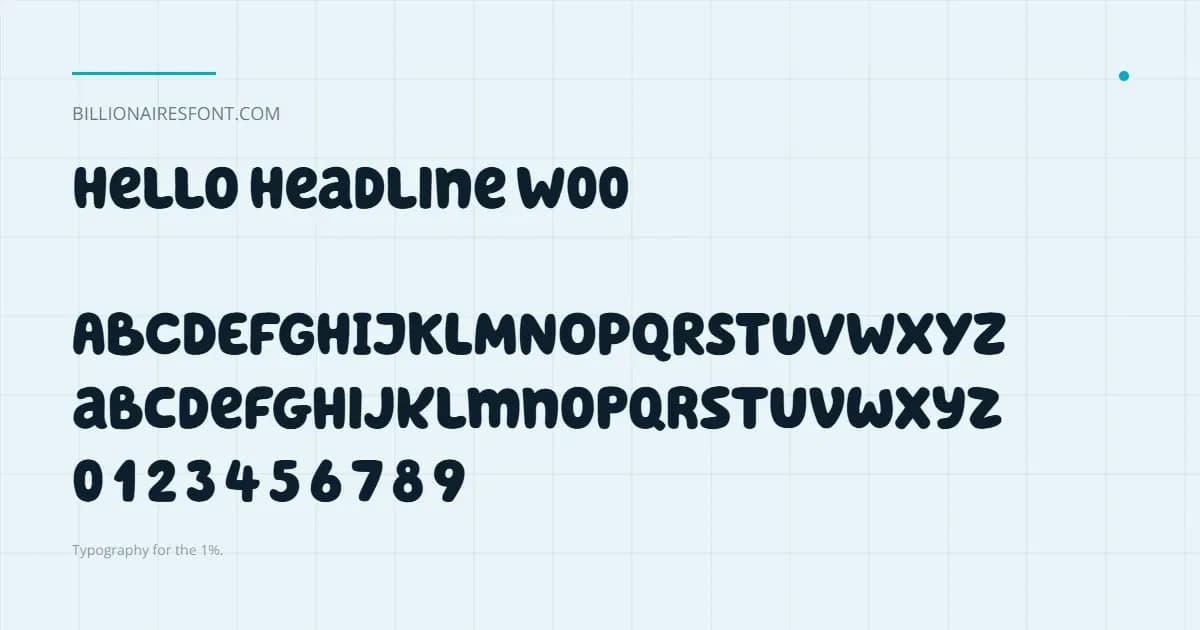
The lowercase here sits low against tall capitals, a roughly 0.71 x-height-to-cap ratio that gives Hello Headline its airy, drawn-by-hand swing rather than the squared evenness of a workhorse sans. Veneta Rangelova drew it for the DearType foundry in 2015 as a display script-sans hybrid, the kind of warm, slightly irregular lettering that suits a greeting more than a paragraph.
It carries a single Regular weight across 365 glyphs, and it's free to download here for personal projects. Most of its life is spent large: on cards, packaging fronts, social headers, and logotypes where a friendly, informal voice does more work than neutrality ever could.
HELLO HEADLINE W00 Font Gallery
TEST HELLO HEADLINE W00 LIVE
TEST HELLO HEADLINE LIVE
Hello Headline W00 in Available Styles
Character Map
TECHNICAL SPECIFICATIONS OF HELLO HEADLINE W00
The Low Waistline That Gives Hello Headline W00 Its Casual Tilt
Set a word in caps and a word in lowercase side by side and the personality shows immediately. With the x-height landing at 500 units against a 700-unit cap height, the lowercase reads small and rounded beneath generous capitals, and that gap is where the informality lives.
Strokes carry a gentle, uneven modulation rather than a ruled monoline, so curves swell slightly through the bowls of the a, e, and g before tapering at the terminals. The t and f keep short, soft crossbars; the dot-bearing i and j sit lightly above the rest.
Nothing here is mechanically repeated, which is the point: the letters look hand-set, not engineered, and that hand quality is what carries a wordmark.
What's Inside the Free Hello Headline W00 Download
The family ships as a single Regular style, no italic and no bold companion, so it functions as a display voice rather than a text system. It's offered in TTF for desktop installation and WOFF2 for web embedding, the latter being the compressed format you'd reference in a CSS @font-face rule for production sites. The glyph set is broad for a display face.
Free to download for personal use; commercial projects need a paid license through DearType, the original foundry. The Access All Alternates feature is the one worth knowing about, since switching between alternate letterforms is how you keep repeated letters in a logo from looking stamped.
Where the Informal Voice Earns Its Place
Hello Headline is built for the moment a layout needs to feel spoken rather than printed. It does its best work on greeting cards, invitations, and event identities, on food and lifestyle packaging where warmth sells, and across social-media headers and short promotional headlines.
The wide Latin coverage means the same friendly tone holds across French, Polish, Turkish, Vietnamese, and dozens of other languages without dropping to a fallback. What it is not is a body face: at caption sizes the low x-height and soft modulation start to close up, and the single weight gives you no hierarchy to lean on for long-form text.
Treat it as a headline and it rewards you; ask it to carry a paragraph and it strains.
Pairing Hello Headline and Its Closest Alternatives
Because the face is warm and a little irregular, it pairs cleanly with something quiet and structured underneath: a neutral grotesque or a humanist sans for the body copy lets Hello Headline own the top of the page without competition.
A restrained slab can also work for subheads when you want a touch more weight. For designers after a similar hand-lettered display mood, Lobster and Pacifico cover the script-leaning end, while Sail or a brush-style face like Caveat sits closer to its casual signage feel. If you need a true text companion that won't fight it, reach for a clean sans such as Open Sans or Source Sans.
Quick Questions About Hello Headline
Is Hello Headline downloaded font free to use commercially?
It's free to download for personal projects. Commercial use requires purchasing a license from DearType, the foundry that produced it.
How many styles come in the Hello Headline family?
One: a single Regular weight. There's no italic or bold cut, which is typical for a display face of this kind.
Which file should I use for a website versus my computer?
Install the TTF on your desktop to use it in design software, and reference the WOFF2 in your CSS for web embedding, since it's the smallest, fastest-loading format.
What pairs well with Hello Headline for body text?
A neutral sans such as Open Sans or Source Sans keeps the contrast clean, letting the headline stay expressive while the body text stays readable.